top of page
CO2.png

Zachary Bouck, CFP®

Hi, I’m Zak. Co-Founder and CIO of Denver Wealth Management. I believe wealth is good, and I help people create it with clarity and confidence.

  • Zachary Bouck
  • Jan 24, 2025
  • 6 min read

Updated: May 8, 2025

Denver Wealth Management Technology Trends 2025


Writing an annual outlook is an exercise in futility. To loosely paraphrase Don Rumsfeld, there are ‘unknown unknowns,’ things that we don’t even know we don’t know. While that uncertainty provides a constant humility in making any predictions, we can at a minimum start with what we do know. From there, we can balance our base of knowledge with what we know we don’t know and begin filtering out less likely scenarios and adding more likely scenarios.


Instead of my annual ‘investment predictions’ I’m changing the format to ‘Technology Trends.’ The cutting edge is fun to write about, but it’s really the long term verifiable trends that matter the most. Personal computers, smart phones, cloud computing, software-as-a-service companies. These are all trends that have made investors fortunes over the past 25 years, and we expect similar dominant trends to continue in the next 25 years.


Looking back at the last quarter-century from the vantage point of year end 2024, the dominant story of the past 25 years is how hand-held devices have made amazing changes in our day-to-day lives. From Uber, to photography, to entertainment, smart phones are the brains we never dreamt of 20 years ago.


And their economic power has richly rewarded equity investors. Companies like Apple, Google, Microsoft, Facebook, and Amazon have risen dramatically and has resulted in the Dow Jones Technology Index returning a staggering 20.80% annualized return over the past ten years.


There is an interesting principle in computing about the speed at which chips can solve problems. Dubbed Moore’s Law, it is roughly the idea that the number of transistors in an integrated circuit can double every two years.


While this framework for understanding potential increases in computing power has proven useful over the past 50 years, computing power has now reached a limit whereby future doubles are harder and more complicated. While Moore’s prediction has been useful, we are reaching a terminal state of easy computing power where future gains will be harder and slower.


We have also reached a level of stagnation when it comes to novel uses of the smart phone. Innovation will continue, but at a slower pace. This means that while investment returns will likely continue to come from what we have dubbed ‘Platform Companies,’ the wave of exponential return will likely come from a different source.


Looking back from 2050, what will the investment story be? Some innovations are likely outside of prediction. If you were to lay wagers at the most likely, we are betting that the power of computers to radically transform our lives are entering a new stage. Wall Street crudely refers to this as "AI." We think that phrase is a good catch all, but not particularly useful when it comes to putting real mental energy into the potential outcomes and usefulness of computing power. The real magic of 'AI' is the new way we have learned to use computers. While previous computers took a somewhat literal search query and used a basic process to generate a result, the new way computers can search, curate, and present information looks as if it will truly uproot the world.


Trend #1 Computing Power reduces White Collar Jobs dramatically


The trend that seems most likely is computing power reducing the need for white collar workers. There have been two big waves of technology replacing human workers: first Agrarian, then manufacturing.


I believe, Service workers are next.


Agrarian


“The share of the US workforce employed on farms fell from 90% in 1790 to less than 2% today.” https://humanprogress.org/trends/the-changing-nature-of-work/


Manufacturing


“Manufacturing employment peaked at 38% in 1944, by 2019 it had fallen to 8.5%.


Service


‘The share of workers employed in the service sector rose from 31% in 1900 to 78% in 1999. In 2016 it stood at 81%.” Just as farm machinery and technology reduced the farming labor force, and machinery severely reduced the amount of manufacturing workers in the US, get ready office workers. AI will substantially reduce the need for people employed in offices engaged in ‘white collar’ work

.

The number of people who sit in front of a computer and organize, search, or format data will be reduced, on a 10:1 scale. The profession of 'computer-looker-atter' is going away, and we as investors need to think about where and what businesses will benefit the most, and which will suffer.


Theme #2 Automated Driving


In 2022, there were approximately 6 million car accidents reported in the US. Vehicle deaths range between 40,000 and 45,000 most years. The average one-way commute in the US is 26.8 minutes and total daily commute time is 53.6 minutes, a number I’m happy to round up to one hour.


The average car is used only 3 hours per week, which means it sits idle 141 hours per week. Additionally, 50-60% of land inside metro areas is set aside for car parking. Humans have only had autos for about 100 years, and our relationship with these glorious transportation machines is still evolving. If regulation continues to favor self-driving over human-driven cars, the technology will have vast impacts over the next 25 years.


For example, if that hour long commute, we just identified is done in a self-driving car, that time is now productive in both directions. As you drive from your office to a meeting, you can continue to work on your computer, while your self-driving car safely shepherds you home. Why not kick back and watch a movie? Play Chess? Anything but stare at the brake lights on the interstate.


You could have your self-driving Tesla drive your kids to school, or even rent out your Tesla to auto-drive other people around.


Not only are self-driving cars less expensive to operate, their 6 times safer, on average, than human drivers. Safer cars cost less in insurance and reduce congestion.  

Winners in this category will necessitate some losers. Legacy car companies that can’t adapt will fail. Technology companies that can produce cars or hardware to outfit cars will win.  


Theme #3 Drone War Fare Dominates the Battle Field


Humans have been killing each other forever. If you’ve read the bible, the first humans not created by God start human history with a murder. Cain & Able is not just a hipster restaurant, it’s the story of mankind.


Ever since that attack in the ancient field, humans have been getting better at killing and defending against the attackers.


Abel’s rock became a club, became swords, became guns, became bombs, became tanks, became airplanes, became drones. (I know in the picture above Cain has a club, but in the bible I read as a kid he had a rock.)


The conflict in Ukraine has re-written many of the current military ideas that we had prior to the Ukraine Russian conflict. Drones, even retail and low sophistication drones are game changers on the battlefield. Small drones with single grenades attached have not only killed countless soldiers but have also led to video-gamers effectively becoming lethal soldiers.


Elon musk weighed in on X, arguing that manned aircraft are no longer going to be a factor in warfare. Drones are not limited by a human’s ability to handle G-forces, but aircraft piloted by individuals are.


With drones phasing into wars, not only will one type of combat end, but a new one will begin. Already in the Ukraine-Russia conflict, being able to pick up drone frequencies of your enemies can help win valuable conflicts on the battlefield. Stealing control of their drones will allow you to take over their weapons.


As far as investments are concerned the US spent $820 Billion dollars, a significant amount that will be redirected to new companies in the coming years.


I won’t review some of the likely benefactors, but the undeniable trend, is that drone warfare, and by extension, counter-drone warfare will become extremely important on the global battlefield.


These three trends are undeniable. Humans are being replaced by AI in service work, self-driving technology is improving everyday, and warfare is being reinvented by drones. The opportunities are ample for those willing to do the homework and invest accordingly.


The opinions voiced in this material are for general information only and are not intended to provide specific advice or recommendations for any individual. All performance referenced is historical and is no guarantee of future results. All indices are unmanaged and may not be invested into directly. Any company names noted herein are for educational purposes only and not an indication of trading intent or a solicitation of their products or services. LPL Financial doesn’t provide research on individual equities.


  • zakwantsrealestate
  • Oct 30, 2024
  • 3 min read


The US economy continues to out-innovate, out-produce, and out-perform every economy in the world. US technology and innovation are the envy of the world. Despite the short-term uncertainty created by a messy political process, our constitutional republic that has lasted over 200 years continues to function and allow innovation and growth to continue.

The US Economy and investments markets are doing as well as can be imagined, so let’s just enjoy it for a second before something comes along and ruins it.


#1 the market is at an all-time, up 22% this year.


This is a symptom of all the causes I’ll point out in the following blog. The economy is rip-roaring, and the stock market is reacting.

#2 GDP

The US Economy continues to grow at a consistent rate. I’m going to say it. Us companies and innovation cannot be stopped. Not Covid, not inflation, not war, can stop the US innovation machine. The French want peaceful lives, American’s want innovative, exciting lives. One is better for your soul, the other better for the economy. The constant innovation, and generally friendly regulation means the US makes better hardware, software, machines, and weaponry than anyone else. It’s good to be on top.


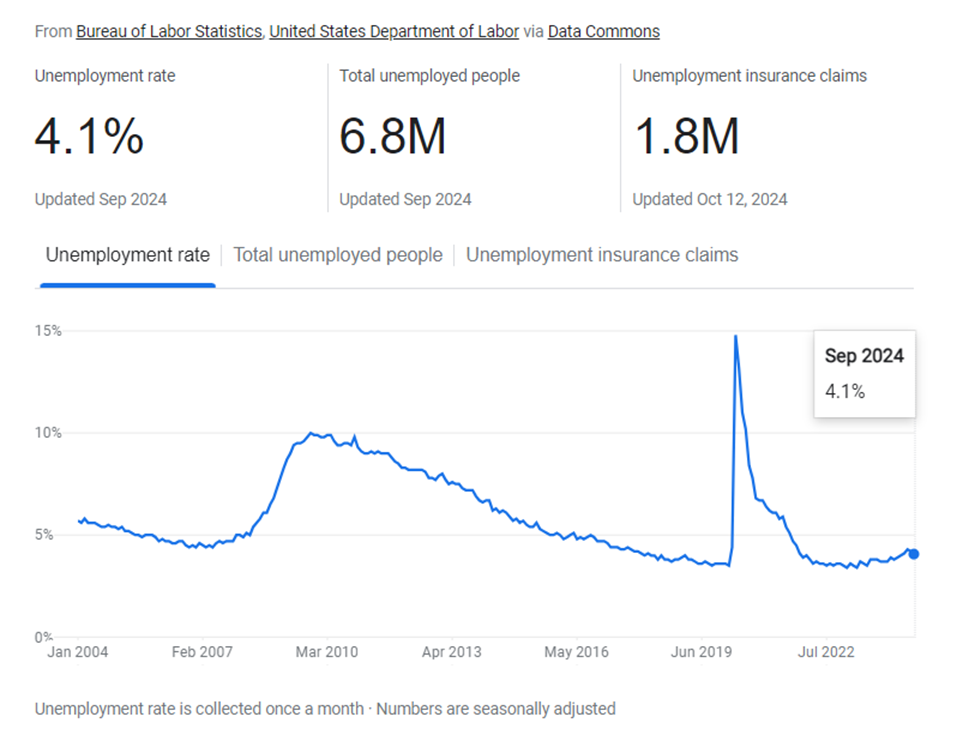
#3 Employment rates continue to stay low, despite record immigration and high interest rates.


#4 Interest rates are trending lower. This is stimulative for the economy.


#5 Oil Prices are low, and because of consistent US energy production. America is no longer beholden to foreign countries for their energy supplies.  


#6 World conflicts are only simmering.

This can be perceived as negative or positive for the world. Generally, when conflicts are simmering it does not lead to all-out war. All-out war (like Ukraine vs Russia) happens suddenly and forcefully. If Iran wanted to go to war with Israel, it would. Like a moth flying into a flame, the US cannot seem to avoid getting involved in all-out wars. The fact that China/Taiwan and Iran/Israel is merely simmering, means the likelihood of a real war is lessened, and I think that’s good for the US.


#7 Housing tells us the story of the economy.

In some ways, housing is the economy. An exaggeration, yes, but it’s the one thing we can’t outsource, build overseas, or move away from. Housing is permanent

“The housing market represents about 15 percent to 18 percent of U.S. GDP, said Lindsey Bell, Investment Strategist at CFRA, citing figures from the National Association of Home Builders. "In other words, a weak or strong housing market can have substantial influence on the direction of the overall economy," Bell added.”

And we need millions of new units to account for the last 14 years of building coupled with record immigration.


There you have it, a quick look at the best it can be. Enjoy October 2024 because we don’t have many months or markets that feel like it.


Content in this material is for general information only and not intended to provide specific advice or recommendations for any individual. All performance referenced is historical and is no guarantee of future results. All indices are unmanaged and may not be invested into directly. The economic forecasts set forth in this material may not develop as predicted and there can be no guarantee that strategies promoted will be successful.


  • Zachary Bouck
  • Oct 2, 2024
  • 3 min read

By: Zachary Bouck, CFP®


Insights on Building Wealth


#1 To achieve wealth, use your cash flow to acquire appreciating assets. I prefer stocks, but options like real estate, collectibles, or other investments can work too.


#2 The more cash flow you generate, the more appreciating assets you can purchase. To build wealth, finding ways to increase your cash flow is essential.


#3 To generate significant income, you must provide unique value that others cannot. This inevitably involves improving various aspects of yourself, enabling you to offer meaningful help to others, who will in turn reward you financially.


This brings us to The 4-Hour Workweek, a book that addresses how to provide substantial value in the shortest possible time. While I’m not a fan of rushing through tasks, Tim Ferriss’s mindset offers intriguing hacks for maximizing productivity.


Though the phrase "4-Hour Workweek" might seem gimmicky, the principles in the book are valuable for achieving our goal of delivering significant value. With limited time each week, we must use it efficiently to accomplish the three objectives outlined above.


The Historical Context of Work


Karl Marx argued that the bourgeoisie seized the means of production, forcing the proletariat into a life of misery. If you were born into serfdom in medieval Europe or as a peasant under the Russian monarchy, it’s hard to dispute his claim.

Consider a scenario where the king owned all the land’s wild game, and hunting for food carried the death penalty. In such a context, it’s evident that the means of survival were controlled by those in power.


Experiencing Historical Hardships


Going camping can give a modern person a glimpse of what life might have been like 200 years ago. Even if you bring food, gadgets, and a comfortable mattress, camping remains tedious. Finding water, dealing with dirt in your meals, bathing in cold streams, and fending off bugs can make you long for a warm shower after just three days.


Even Marx, in his ideal scenario, suggested that people might work just eight hours a day if conditions were right. Thus, the notion of a 4-Hour Workweek is audacious. Who can fathom working only four hours a week when the norm is eight hours a day?


This bold claim is likely what contributed to Tim Ferriss's monumental success with the book. Following the traditional trajectory of school, job, marriage, community, and retirement, the idea of a 4-Hour Workweek seems exaggerated.


Ladders of Wealth Creation


Our discussion connects closely to the “ladders of wealth creation.” After seven podcast episodes delving into Nathan Barry’s concepts, I believe we can enhance our approach for 2024—let’s call it Ladders of Wealth Creation 2.0.


Evaluating the Ladders: Can You Achieve a 4-Hour Workweek?


  1. 1st Ladder: If you’re paid by the hour, a 4-hour workweek won’t accumulate wealth due to limited income potential. While you might reduce hours in a salaried position through efficiencies, revealing those efficiencies could jeopardize your job.

  2. 2nd Ladder: Highly unlikely. Some high-commission careers, like commercial real estate or heavy equipment sales, are very competitive.

  3. 3rd Ladder: Yes, but only after years of work. “Get rich quick” schemes, like stock trading or drop-shipping, are also competitive, and any market inefficiencies you find may vanish quickly.

  4. 4th Ladder: Yes, if you have capital, royalties, or rental income. Creating income through an investment portfolio, real estate, or passive content (like music or videos) makes a sub-10 hour workweek feasible.


Key Takeaways


During our podcast on this topic, we discuss how Tim’s idea that “life is negotiable” is a powerful notion today. Regardless of your parents’ jobs or your field of study, all four ladders of wealth creation are available to you. Transitioning between them can be daunting, but if your goal is to reduce work hours or increase cash flow, it’s essential.


When reading The 4-Hour Workweek, focus on what resonates with you and set aside what doesn’t. Personally, here are my key takeaways:


  • Life is negotiable.

  • Strive for effectiveness, not just efficiency.

  • Time, mobility, and options matter more than a specific income goal.


Everyone may draw different lessons from this book, making it worth reading and revisiting every few years.


Disclosures: The opinions voiced in this material are for general information only and are not intended to provide specific advice or recommendations for any individual. All performance referenced is historical and is no guarantee of future results. All indices are unmanaged and may not be invested into directly. Stock investing includes risks, including fluctuating prices and loss of principal.​ There is no guarantee that a diversified portfolio will enhance overall returns or outperform a non-diversified portfolio. Diversification does not protect against market risk.​ ​The economic forecasts set forth in this material may not develop as predicted and there can be no guarantee that strategies promoted will be successful


Zachary Bouck

Screenshot 2024-04-15 131932.png
  • alt.text.label.Twitter

©2023 by Zachary Bouck. Proudly created with Wix.com

Securities offered through LPL Financial, Member FINRA/SIPC. Investment Advice offered through Denver Wealth Management, a registered investment advisor and separate entity from LPL Financial. The LPL Financial registered representative(s) associated with this website may discuss and/or transact business only with residents of the states in which they are properly registered or licensed. No offers may be made or accepted from any resident of any other state. InvestmentNews’ 40 Under 40 nominations of advisers and associated professionals are evaluated based on: accomplishment to date, contribution to the industry, leadership and promise.

bc_logo_large.png
bottom of page